

As a child, I can remember watching intense lightning and electrical storms in the French mountains. The lightning zigzagged and arced across the sky, intermittent flashes revealing the forest below. The forks glowed white, green and purple, interspersed with deafening claps of thunder. I find lightning both terrifying and beautiful, which creates a heady fascination. The lightning is an obvious spectacle, but it is the tension in the air that really fascinates me. I wrote briefly about this in the text for my book The Island.
‘He sat one evening on a wall talking to a friend, a distant summer storm approaching, the flashes intermittent and the thunder occasionally breaking the silence of the night. They watched the lightning arc across the sky and felt the first approaches of the storm in the air.... it was a time for everything.’
Given this interest, I find it unusual that I haven't sought out storms more often. I have witnessed some dramatic lightning storms, often while on holiday in the mountains of Europe, but I have never really felt the urge to photograph the lightning. This could be because the lightning often seems to be at its most intense after dark, making it harder to capture, or because I don't enjoy working with a tripod and very rarely take one on holiday with me. As a teenager, I did once try to photograph lightning from my bedroom window in the Midlands. Unfortunately, it was just sheet lightning without any discernible forks, and what I ended up with was a roll of film that was mostly out of focus, with yellow and white tinged skies. Identifying it as lightning was not helped by the excessive light pollution in the Midlands.
At the end of the last heatwave in June, I was watching the forecast, hoping for some thunderstorms. Although I haven't managed to photograph lightning before, I have thought about capturing it for some time. I suppose it is not just the lightning that interests me; there has to be a relevance to the place or the location, and then the lightning elevates and adds something to the sense of place. I imagined being able to photograph a scene for my series Vale, visualising a figure sitting inside a barn on the top floor, looking out across the landscape with lightning in the distance. This never happened because I couldn't find the right location and because of the relative scarcity of lightning in England.
However, it now looked hopeful. Lightning was forecast and I was closely monitoring the weather apps. I also discovered a website that showed lightning strikes in real time. This was really helpful, as I could see which direction the storm was moving in and, like any storm chaser worth their salt, I wanted to make sure I placed myself in its path.
I initially drove up onto Dartmoor, thinking it would give me a large expanse of sky and that I would hopefully see the storm moving towards me. I parked close to Vixen Tor and got out of the car. The sky was swirling in slow motion, muted greys tinged with amber. I was suddenly aware of how vulnerable I felt, how much sky there was, and how small I was, nervously checking the lightning strike app to make sure I wasn't about to be lit up. I could soon see, both from the app and from the landscape, that the storm was moving further east of me. In these situations it is always hard to know whether you're making the right decision. I got back in the car and drove to the other location I had considered: Brent Tor, an isolated church built on a rocky outcrop. It took me fifteen minutes to reach the car park. I parked up and checked the app. The storm was close now. When I got out, the sky had darkened and seemed somehow lower. I looked up at the church beneath the dark, swirling sky and thought, Do I really want to be standing on a rocky outcrop with a tripod? Time for Plan C.
I got back in the car and turned off the main road, passing through the village and around to the other side of the Tor, where I knew I could see the church in the distance on the hill. I parked in the lane with my hazard lights on and decided I could photograph from inside the car using a tripod. I set it up over the passenger seat and opened the window, as it is usually the case with thunderstorms that the rain tends to follow the thunder and lightning. I had recently bought an ND filter for my 50mm lens to allow for longer exposures in brighter conditions. What would have been really helpful, however, would have been to do some basic research on photographing lightning. Even with thirty years' experience, you can still make stupid mistakes, especially when you feel under pressure, are doing something for the first time and are dealing with lots of variables. In this instance, I thought, Oh great, I can whack the ND filter on and take 20-second exposures so I don't have to keep taking pictures every few seconds.
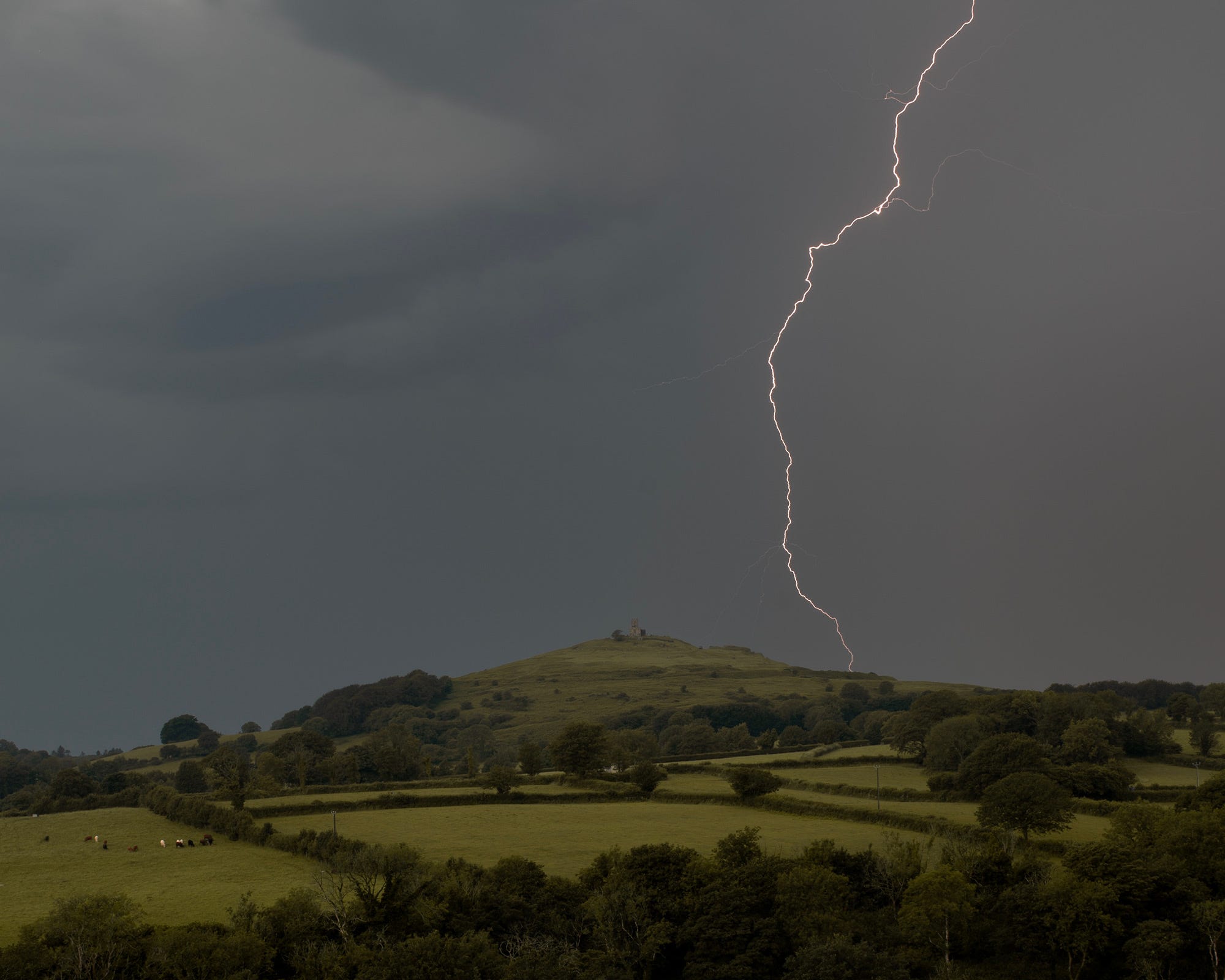
The location was ideal. I was in the right place. I framed the image, set up the cable release and started taking pictures. There were some small forks at first, but nothing that impressive. Then, suddenly, after a few minutes, there was the most unbelievable crack of thunder, coinciding with a massive bolt of lightning that cut through the sky directly above the church. I wasn't checking the images on the camera because I was afraid I would miss another strike if I looked away. Instead, I kept shooting, happy with my long exposures. The lightning started to move to the right of the church, so I quickly decided to switch to my 35mm lens, for which I didn't have an ND filter. The exposure was now only a few seconds. I took another picture and then a bolt of lightning came down not far from the church, striking the ground nearby. I must have got it. The storm rumbled away for some time afterwards, but there were far fewer strikes and nothing as impressive as the few I had already witnessed. As I was packing up, bizarrely, there appeared to be headlights by the church, it was dark now. I wondered how a car could possibly have got up there. I soon realised it must have been a farmer on a quad bike with intensely bright lights checking on the cows.
Once the storm had passed, I started to look through the images on the camera. Where was the lightning? All I had were muddy skies. It was the Midlands all over again. I found the image with the immense bolt when the storm was overhead, but it had registered as little more than a thin white line. I soon realised my mistake: by using such long exposures, I had effectively washed out the lightning strikes. Thankfully, I had switched to the 35mm lens for a few photographs, which at the time I thought had been a mistake, as the strike near the church would have worked better aesthetically with the 50mm lens. I was lucky to get the picture I did, one that I am happy with and that I know will work well within a series I am currently working on. Making mistakes is always the best way to learn, but thankfully, in this instance, I was lucky enough to capture something. If we get more storms, I'll be much better prepared.
I'd feel a bit vulnerable up on Dartmoor doing that! From the shoreline out to sea even feels somewhat safer.